Your customers don't care about your racks — they care that their services work. The SLA (Service Level Agreement) measures it for each customer, and your reputation sums it up for the whole market.
¶ 🩺 The state of a unit
At any moment, each of a customer's units is in one of these states:
| State | What it means | Billed? | Counts as available? |
|---|---|---|---|
| 🟢 Running | Placed, reachable, fast enough | ✅ | ✅ |
| 🟡 Degraded | Server saturated, network too slow or losing packets | ✅ | ❌ |
| 🔴 Disconnected | Server off or failed, or no route to the Internet | ❌ | ❌ |
| ⚪ Pending | No server could take it | ❌ | ❌ |

¶ 📐 How the SLA is measured
A customer's SLA is its measured availability since the start of its current contract term (signature or last renewal): the share of time its units were running properly.

- As long as the SLA stays above the target of the customer's tier, an outage costs you nothing more than lost billing.
- Below the target, each unavailable unit triggers an hourly refund (SLA penalties in your finances). Higher tiers get refunded a bigger share.
- If the SLA stays below target longer than the customer's patience (short for Enterprise, generous for Starter), the customer cancels its contract.
The SLA is cumulated over the whole term. A customer halfway through its contract absorbs an occasional outage better than one who just signed or renewed — be extra careful with fresh contracts!
¶ 🔔 Early warnings
You are warned before it's too late: if, at the current pace, a customer would fall below its target soon, its SLA is flagged at risk — a notification, then an alert at the bottom of the screen until things recover.
The bottom bar permanently lists ongoing alerts: failures whose repair hasn't been ordered, saturated servers, missed or at-risk SLAs, an unpaid loan installment, a delivery waiting for room…
¶ ⭐ Reputation
Your reputation goes from 0 to 100 and starts halfway. It slowly follows the quality of service of all your units.
It matters for three things:
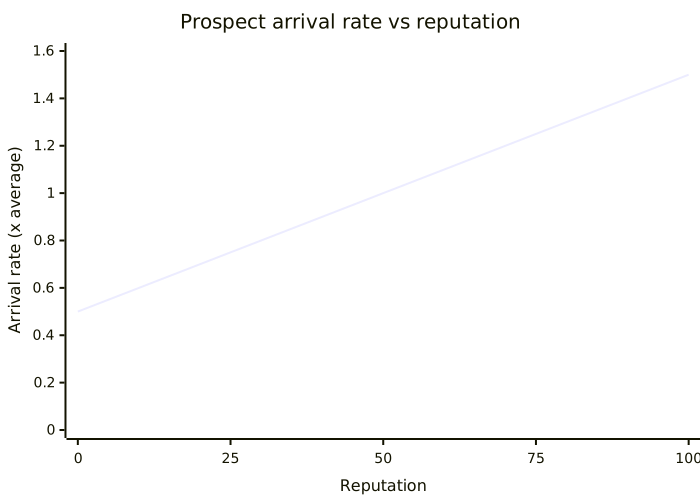
- 📥 How many prospects show up — from half as many (reputation 0) to one and a half times as many (reputation 100) as at average reputation.
- 🔓 Unlocking customer tiers — each tier requires a minimum reputation (see Customers and Contracts).
- 🔁 Renewals — the better your reputation, the more likely customers renew at the end of their term.
Losing a customer because of a missed SLA costs you reputation points on top of the lost income. A good reputation also improves your chances when negotiating a higher price.
Reputation is slow to build and quick to lose. Investing in redundancy, spare capacity and spare parts is investing in reputation.